
What is PHPMailer and what is it for?
Hashtags: #Mail() #Form
On some servers the PHP mail() function is not available.
This function is increasingly commonly disabled on servers as a security measure.
It is usually disabled to protect against SPAM, Mail Spoofing, and Proxy Mail Servers.
If any of the hosted websites were compromised by a malicious user, the mentioned risks are avoided by disabling this function.
The PHPMailer library
The PHPMailer library allows us, among other features, to establish an SMTP connection with a mail server. This SMTP server will be the one that actually sends our email.
The official project website on GitHub contains the documentation with installation and configuration options.
The link to Github is: https://github.com/PHPMailer/PHPMailer.
Installing PHPMailer
- Download PHPMailer from https://github.com/PHPMailer/PHPMailer.
Press the green Code button and then click Download ZIP in the Clone box.
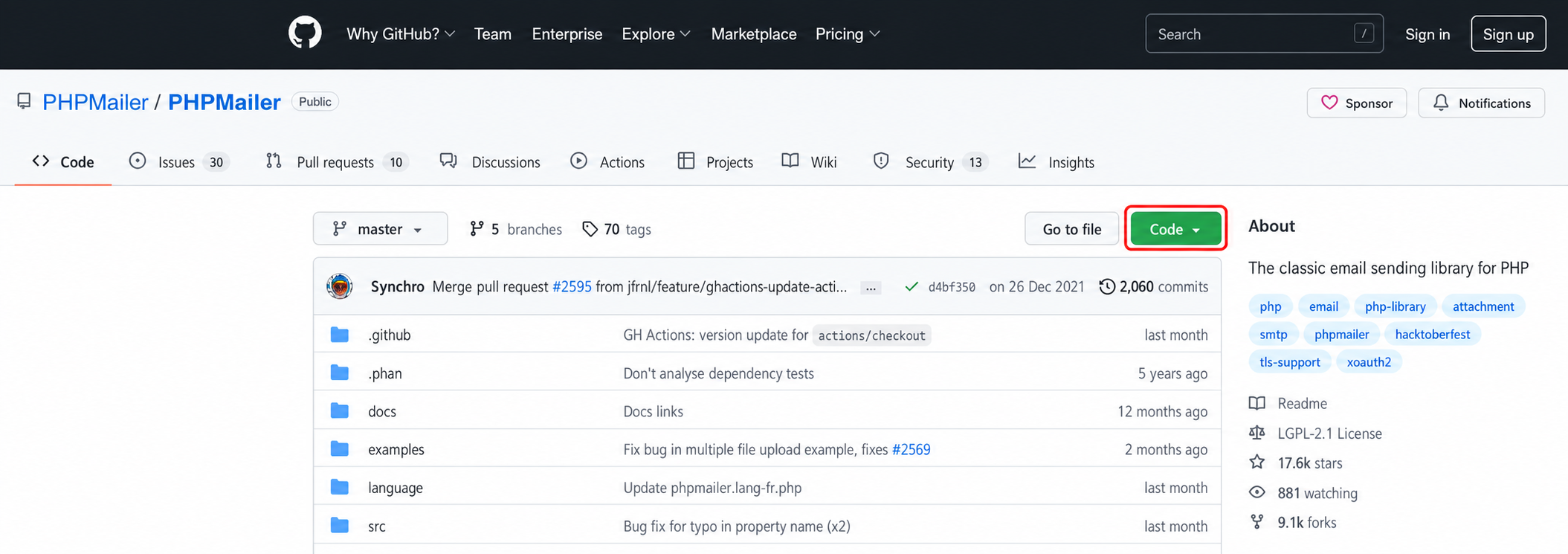
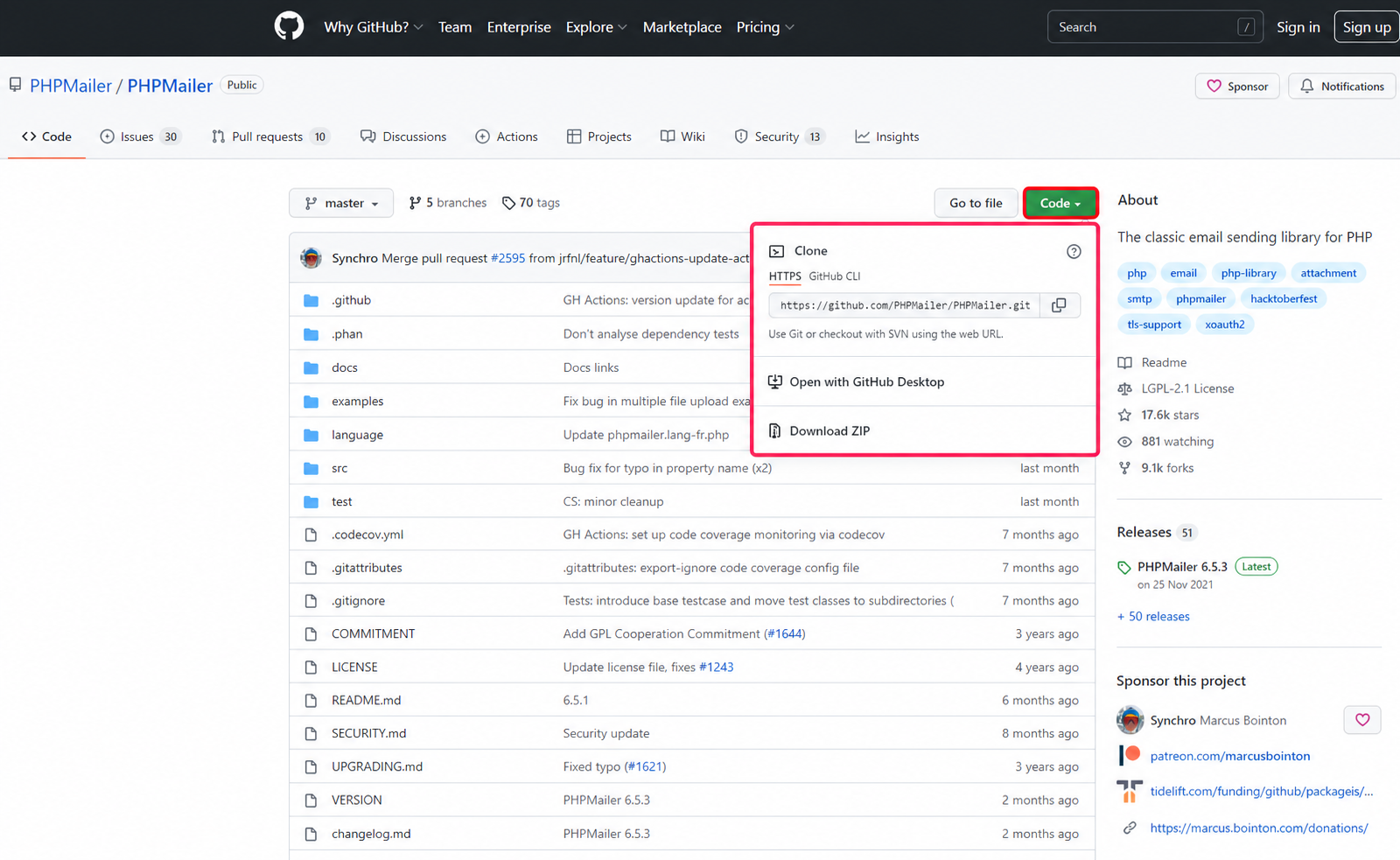
- Unzip the downloaded file “PHPMailer-master.zip” and rename the PHPMailer-master directory to PHPMailer
- Copy the PHPMailer directory into the root of your website (for example public_html). To verify that the paths are correct, from the root of our project there should exist: /PHPMailer/src/PHPMailer.php
Example configuration
- Save the following code in a file, for example, example.php
// Some code<?php
// Display PHP errors (Disable in production)
ini_set('display_errors', 1);
ini_set('display_startup_errors', 1);
error_reporting(E_ALL);

// Include the PHPMailer library
use PHPMailer\PHPMailer\PHPMailer;
use PHPMailer\PHPMailer\Exception;
use PHPMailer\PHPMailer\SMTP;

require 'PHPMailer/src/Exception.php';
require 'PHPMailer/src/PHPMailer.php';
require 'PHPMailer/src/SMTP.php';

// Start
$mail = new PHPMailer(true);

try {
    // SMTP Configuration
    $mail->SMTPDebug = SMTP::DEBUG_SERVER;                         // Show output (Disable in production)
    $mail->isSMTP();                                               // Enable SMTP sending
    $mail->Host  = 'CONFIGURAR_SERVIDOR_SMTP';                     // SMTP server
    $mail->SMTPAuth  = true;                                       // SMTP authentication
    $mail->Username  = 'CONFIGURAR_USUARIO_SMTP';                  // SMTP username
    $mail->Password  = 'CONFIGURAR_CONTRASEÑA_SMTP';	          // SMTP password
    $mail->SMTPSecure = PHPMailer::ENCRYPTION_STARTTLS;
    $mail->Port  = 587;
    $mail->setFrom('hola@prueba.com', 'Your name');                // Email sender

    // Recipients
    $mail->addAddress('prueba@midominio.com', 'Recipient name');  // Recipient email and name

    // Email content
    $mail->isHTML(true);
    $mail->Subject = 'Email subject';
    $mail->Body  = 'Email content <b>in HTML!</b>';
    $mail->AltBody = 'Email content in plain text for mail clients that do not support HTML';
    $mail->send();
    echo 'The message has been sent';
} catch (Exception $e) {
    echo "The message was not sent. Mailer Error: {$mail->ErrorInfo}";
}
- Modify the connection parameters in this file, the sender’s email and the recipient where we will send our test email.
Search for the following lines in the script and replace the data with your own.
It is very important to configure these details using a valid mailbox that you can access!
// SMTP Configuration
$mail->Host  = 'mail.tudominio.com';   // Here you must configure the SMTP server
$mail->Username  = 'casilla@tudominio.com';  // This will be the mailbox that sends the mails
$mail->Password  = 'contraseña de casilla';  // Password for your mailbox
$mail->setFrom('casilla@tudominio.com', 'Your name'); // Configure your name and the sender mailbox
Below you will see this section to fill in with your data:
// Recipients
$mail->addAddress('prueba@otrodominio.com', 'Recipient name');  // Recipient email and name
And the last section to fill in with your data:
// Email content
$mail->isHTML(true);
$mail->Subject = 'Email subject';  // The subject that the sent email will show
$mail->Body  = 'Email content <b>in HTML!</b>';
- Upload via FTP or, using the File Manager in cPanel, the PHPMailer directory and the example.php file to the root of the public directory of your website (public_html).
- Run the example from
https://tudominio.com/ejemplo.php.
It will show you the debug output of the process and then you will receive the email:
“The message has been sent”
If it shows any error, either from PHP or from the SMTP connection, you should debug the source of the problem. The error message you would receive in that case is:
“The message was not sent. Mailer Error:”
In production, remember to disable PHP and SMTP debug by changing the first lines of the test code:
ini_set('display_errors', 1);    // Change the 1 to 0
ini_set('display_startup_errors', 1); // Change the 1 to 0
error_reporting(E_ALL); // Change "E_ALL" to 0